
DEEP FIELD INVESTIGATION / INDIAN PHYSICAL CULTURE
Ancient Clubs,
Modern Bodies:
A 2,500-YEAR-OLD PRACTICE
FOR MIND, MOVEMENT, AND COMBAT
Why swinging heavy wooden levers through Kerala forests thousands of years ago holds the missing key to rotational resilience, shoulder longevity, and true real-world physical competence.
Archival Research & Combative Movement Specialists
01 Movement Before Fitness: Solving Problems in Southern India
The Foundational Law of Functional Movement
“Movement is a behavior designed to solve problems. If there is no real-world problem, there is no adaptive reason for the organism to move.”
— Erwan Le Corre, Founder of MovNat
Something I’ve always said is that movement is a behavior designed to solve problems. If there’s no problem, there’s no reason for the body to move. So let’s start with a very real problem people faced in southern India thousands of years ago:
You’re a hunter moving through dense forest and steep hills. The animals you’re tracking can outrun you. The terrain can twist your ankle or drive you into rocks unless you know how to break your fall. And somewhere in that same landscape are large predators, tigers, who see you as potential prey. The question isn’t “How do I get a good workout today?” It’s “How do I move through this environment, find food, and not die?”
In that context, movement patterns had clear jobs. You need to approach quietly, change levels quickly, get in and out of trees and rocks, generate force into an animal with a strike or a thrown weapon, and recover your balance under stress. Early, crude forms of what would later be known as kalaripayattu, a South Indian martial art rooted in the forests and hills of Kerala, grew out of this reality: techniques for shielding yourself, evading, striking, and using simple tools in ways that helped hunters come home alive when big cats and other threats were part of the daily equation.
That’s the root we’re interested in. Before kalaripayattu became a formal martial art or a performance discipline, it was a survival toolkit for human bodies in dangerous terrain. Framed this way, it looks a lot less like “ancient exercise” and a lot more like what we mean by natural movement: behaviors organized around real environmental problems, not abstract gym goals.
02 Kalari: From Forest Survival to Battlefield Practice
Etymological Origin (Malayalam)
KALARI (കളരി)
Historically designated as an earthen arena, sanctified training dugout, or dedicated combat ground carved below earth-level to naturally regulate tropical heat.
Spatial Arena
Etymological Origin (Malayalam)
PAYATTU (പയറ്റ്)
Denotes rigorous physical exertion, dynamic martial practice, continuous combative discipline, and kinetic mastery over one’s physiological vessels.
Kinetic Mastery
Between 200 BCE and 600 CE, these instinctual forest survival tactics crystallized into Kalaripayattu—widely recognized by physical anthropologists as one of the oldest systematic martial and movement lineages on Earth. By the 11th and 12th centuries, under the warring reigns of the Chola, Chera, and Pandya dynasties, Kalari became the core discipline for royal warrior castes.
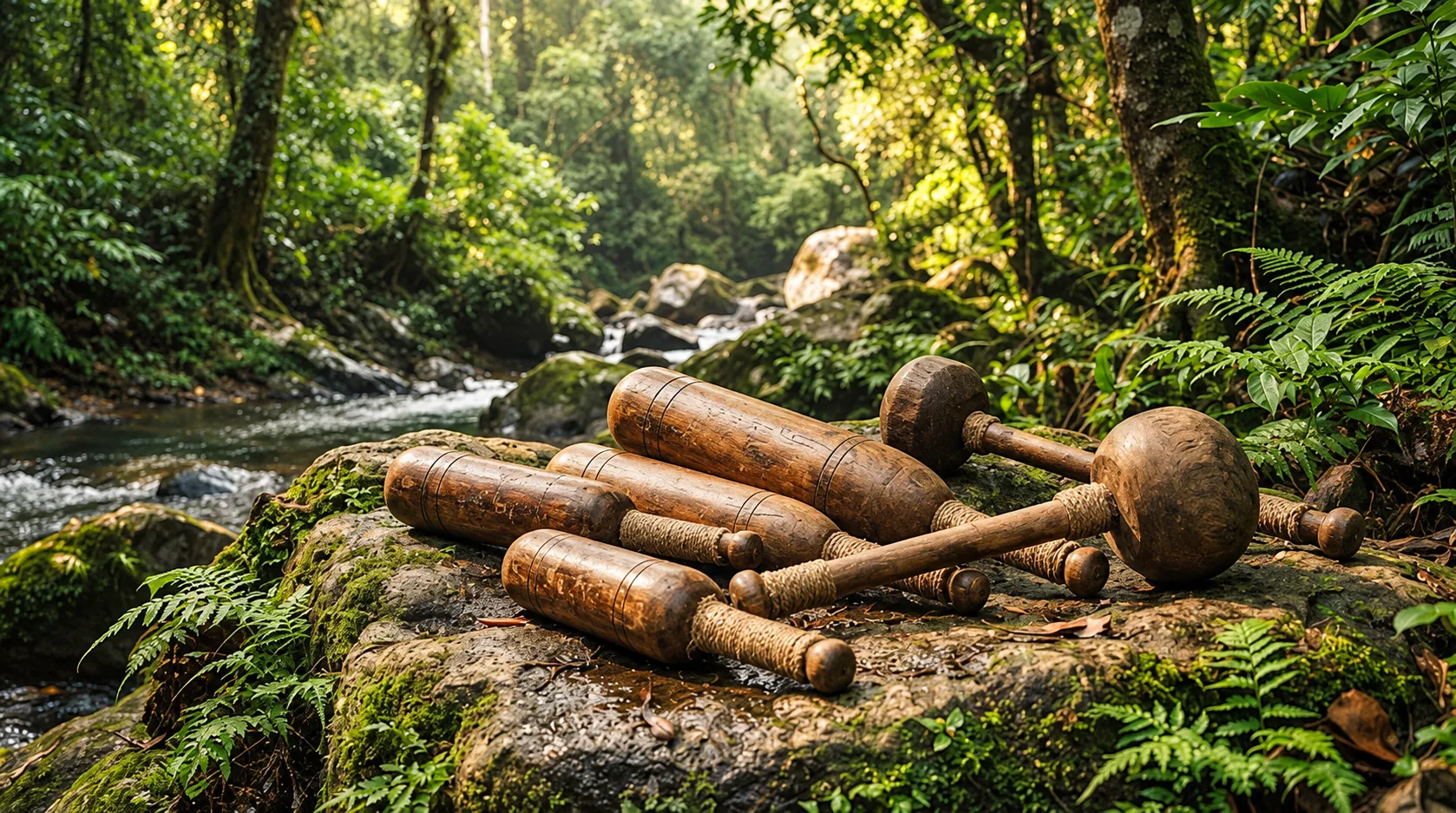
The foundation of Kalari is grounded in Vadivu—eight primal animal postures mirroring the natural biomechanics of the lion, wild boar, snake, elephant, horse, and fighting rooster. Before a practitioner was ever handed a steel blade, they spent years conditioning their joints through sweeping circular levers: wooden mudgars, heavy clubs, and stone-tipped maces.
Combat & Healing: The Marma Integration
Crucially, traditional Kalari was indivisible from Kalari Chikitsa (healing therapy) and the precise study of 108 Marma points (vital neuro-fascial junctions). A warrior trained to inflict force was equally trained to restore joint mobility, clear fascial blockages through herbal oil massages (Uzhichil), and rejuvenate compromised connective tissues.
03 The 4 Primal Strength & Weapon Implements
Modern kettlebells and dumbbells locate their center of mass cleanly inside the palm. Ancient Indian implements did the polar opposite: they leveraged the physics of asymmetrical distance to awaken the central nervous system.
01 Agility & Flow
Indian Heavy Clubs
Light-to-medium conical wooden levers swung in continuous concentric and eccentric circular patterns (mills, casts, reversals). Restores scapular glide, opens the glenohumeral capsule, and eliminates frozen shoulder patterns.
Mass: 2kg – 8kg Transverse Flow
02 Rotational Power
The Mudgar (മുദ്ഗർ)
The quintessential Indian heavy bat, densely tapered with maximum mass positioned at the distal terminal. Requires intense grip engagement, ribcage stabilization, and thoracic rotational deceleration.
Mass: 6kg – 20kg+ Deceleration Shock
03 Posterior Chain
The Gada (Mace)
A long bamboo or teak shaft capped with a dense stone, cast-iron, or compacted concrete sphere. Executed through 360-degree pendular sweeps that bridge pelvic strength directly into upper-limb whip mechanics.
Mass: 8kg – 35kg Torso Arch-Brace
04 Multi-Planar Bar
The Samtola (Sumtola)
The original wooden barbell carved from an unbroken log, balanced with dual ergonomic hand notches. Used for loaded asymmetrical clean-and-presses, deep Hindu squats (baithaks), and overhead carries.
Mass: 15kg – 40kg Whole-Body Armor
The MovNat Constraint Law
“The human nervous system has no concept of commercial fitness equipment. It responds purely to physical variables: leverage distance, center of mass, angular velocity, and the threat of instability.”
Practical Starter Movement Routine
Actionable Field Protocol
Integrate these foundational movements before heavier loaded sessions to stimulate connective tissue perfusion and awaken the kinetic sling:
1. Front Pendulum Swing (Mudgar)
3 sets × 15 reps each side
Maintain smooth rhythmic breathing and steady hip rooting.
2. Shield Cast (Heavy Club)
4 sets × 10 reps alternating
Ribs down, glutes fired, decelerate behind shoulder line.
3. Offset Farmer Walk (Samtola)
3 rounds × 40 meters
Single-arm asymmetrical rack posture with upright spine.
04 The Colonial Detour & Mid-Century Disappearance
How did a training methodology that sustained India’s martial warriors and kushti wrestlers for millennia vanish from modern gyms? The historical trajectory reveals a fascinating story of imperial conquest, global appropriation, and commercial reductionism.
Early 1800s
British Military Obsession & The “Indian Club” Craze
British East India Company officers observing kushti wrestlers in northern akharas were stunned by their monstrous shoulder girth and complete immunity to chest fatigue. The military brass imported the tools to England, renaming them “Indian Clubs” and codifying rigid, militarized calisthenic drills across the British Empire.
1904 & 1932
Olympic Gymnastics Recognition
Club swinging was officially featured as a medal gymnastics sport at the 1904 St. Louis and 1932 Los Angeles Olympic Games. It was simultaneously championed by British suffragettes as an effective weapon for self-defense against street harassment and police brutality.
1950s – 1990s
The Barbell Hegemony & Machine Quarantine
Post-WWII fitness culture shifted decisively toward linear maximum loads: the Olympic barbell, the bench press, and isolated bodybuilding machines. Rotational swinging was deemed “hard to standardize” and unsafe for untrained commercial gym patrons. The mudgar retreated back into rural Indian dirt pits.
Present Day
The Natural Movement Renaissance
Today, physical therapists and elite movement practitioners recognize that human beings rarely operate in purely linear planes. To throw, climb, sprint, or grapple, the torso must store elastic rotational energy. The ancient club has returned as the ultimate remedy for the hunched, screen-bound modern human.
05 Capability, Flow, and Central Nervous System Integration
When you press a dumbbell overhead, you recruit your anterior deltoid and triceps along a predictable vertical track. When you cast a 12-kilogram mudgar behind your neck, gravity accelerates the distal weight in an arc. You must fight centrifugal force, actively open the shoulder capsule, contract the contralateral obliques, and dynamically decelerate the weapon before reversing momentum.
Midline Crossing
Forces left- and right-brain hemispheres to communicate synchronously across the corpus callosum during complex orbital casts.
Fascial Tensioning
Hydrates neglected connective tissues across the spiral and deep front fascial lines, building armor against acute shoulder tears.
Tactile Feedback
Raw seasoned timber absorbs palm sweat and transmits kinetic micro-vibrations that synthetic rubber weights completely dampen.
Official Affiliate Spotlight Timba.fit
Craft & Loaded Lever Education
Reviving India’s ancestral woodcraft and loaded lever education under strict MovNat natural movement principles.
Sudhir
Founder, Artisan & Master Trainer
Growing up across Indian military defense bases, Sudhir faced a life-altering cancer diagnosis in 2009. Refusing to surrender physical autonomy, he relocated to rural Kerala to immerse directly in traditional Kalaripayattu. By swinging heavy mudgars and gadas, he rebuilt his shoulder girdles, spine, and vitality from scratch.
2021 Indian Army Commission: Designed lower-body & rotational strength regimens for active defense regiments.
Sport Singapore Accredited: Certified over 85+ international movement coaches and physiotherapists.
The Timber Philosophy
Every Timba club is 100% handcrafted from seasoned native hardwoods, finished exclusively with natural plant oils. Zero polyurethane, plasticizers, or slick chemical lacquers—preserving raw dermal friction and grounding tactile touch.
timba.fit
@timba.fit
“We do not swing heavy wood to build vanity muscles.
We swing to reclaim the joint integrity that human civilization forgot.”
Join the movement of movers, therapists, and outdoorsmen re-establishing primal human competence through the ancient discipline of club training.